


Delhi Police’s Unlabelled AI Edits Make Real Photos Look Fake
Enhancing real photos with generative AI can leave artefacts that make authentic scenes look fake. Delhi Police’s protest images show how.

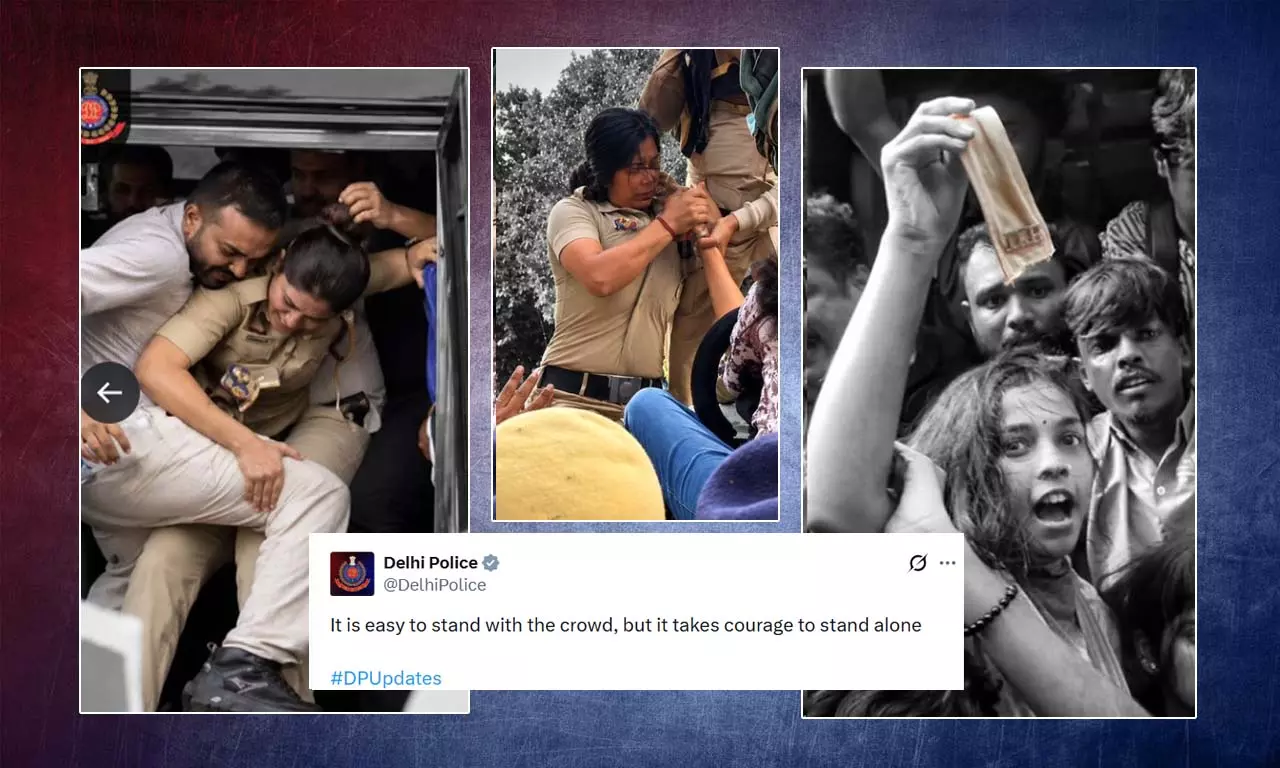
Following days of protests, police crackdown and widespread detention of protesters, Delhi Police on October 15 posted a series of four images. Three show female police officers in distress amid scuffles with protesters, while the fourth shows a protester holding up a torn police epaulette.
The images, which use selective colouring, were shared to highlight the plight of police personnel dealing with protests. Users and some fact-checkers called them AI-generated after detection tests came back positive, and proposed Community Notes pointed to oddities such as an unrecognisable badge.
However, years of fact-checking AI-generated visuals have taught us that a detector’s output is one clue among many, and should be tested against other evidence before it is believed. BOOM pairs detection tools with context analysis and open-source techniques to work out where an image came from and what it shows.
BOOM consulted WITNESS, a human rights non-profit, which shared the images with five teams of media forensics experts from its Deepfakes Rapid Response Force. The teams used detection tools, visual forensics and provenance checks.
The teams of experts traced three of the four images back to what appear to be real photographs or footage, with AI artefacts in two of them coming from AI enhancement. The fourth has no traceable source and is likely synthetic, though experts could not say whether it was generated from scratch or built on a real photograph.
What the images show
All four are in black and white, with colour kept on select elements to draw the eye: the epaulette in the first image, and largely the officers in the rest. Each carries a Delhi Police logo.
Click here to view an archive of Delhi Police's post.
Several users comment to the post, calling it out as AI-generated. Some even included screenshots of AI detection tools showing a positive result.
Could these detection results rule out these visuals as fake?
What the experts found
BOOM has numbered the images in the order the experts reviewed them.
Image 1 ( protesters with torn police epaulette)
None of the five teams found evidence of AI manipulation, and Cauth AI, a team that combines several AI detectors with source tracing, concluded it is a real photograph with editorial changes to the colour and logo.
They also found a coloured version of the photo online but could not say whether it is the original or a recoloured copy.
Image 2 (officer in scuffle surrounded by hands)
Using a reverse image search, BOOM was able to trace the second image to a photo published by The New Indian Express, thus establishing provenance.
One of the expert teams independently traced the image to the same photo.
Cauth AI found Image 2 to be a “fully regenerated” version in which details such as a ring, a tattoo and a hand in the background are lost, though its meaning and context do not appear to have changed. The other teams of experts flagged the image as AI-generated, likely due to the regeneration of the photo.
Image 3 (officer having her epaulette grabbed)
Cauth AI rated it synthetic, and Recod.ai, MeVer and a fourth team also found signs of AI. Only the OU XGMT team rated it likely authentic. Recod.ai could not tell whether it was entirely fake or generated from a real photograph.
One of the teams also found a coloured version of this image shared by media outlet Republic on Facebook, which includes further inconsistencies such as extra fingers on a hand.
Image 4 (officer in a bus)
Cauth AI found a near-identical frame in a video of unverified origin posted on X. Its detectors rated the video likely real, so it concluded the image was probably taken from it and enhanced with AI super-resolution.
OU XGMT and a fourth team rated the image likely real, Recod.ai rated it very likely AI-generated
Why the images set off detectors
In Image 4, Cauth AI flagged the badge, the water bottle and the boot as areas of suspicious structure, while Recod.ai noted poorly defined fingers, unnatural fingernails and an overly smooth uniform.
Colour grading and gamma correction don’t trip most detectors, a media forensics expert in WITNESS’s network said. Generative edits such as super-resolution or regeneration do introduce artefacts, and “such tools should not be used for editorial purposes”. The expert placed Images 2 and 4 in this category.
MeVer’s heat maps showed the most suspicious areas in Images 2 and 3 matching the coloured parts, which could mean an AI tool was used for colourisation. Its detectors can’t tell whether the tool only added colour or also altered details.
SynthID, the watermark Google and OpenAI's tools embed, shows that an image was generated or altered with such a tool, WITNESS told BOOM, but not whether it was fully generated or only edited, with even minor edits triggering detection models.
SynthID results are not always conclusive either. According to Google, a detection means all or part of an image was created or edited by its AI, and that in some cases the tool cannot say either way. Furthermore BOOM's fact-checkers have in the past observed Gemini’s SynthID check giving contradictory answers about the same image or video.
The missing label
Delhi Police’s post carried no indication that AI had been used. Anyone who spots an artefact can therefore write off the whole image, and the real events behind it.
Cauth AI warned that bad actors could use a regenerated image like Image 2 to deny the authentic photograph it came from. It said such enhancements should be done only in colour, noise and signal space, not with generative AI.
BOOM has asked Delhi Police for the original, unedited images and had not received a response at the time of publication.
